Samsung vs OnePlus
Samsung is one of the largest smartphone brands, offering phones across flagship, mid-range, and budget segments. Its current premium lineup includes the Galaxy S26 series, with the Galaxy S26 Ultra at the top. The Ultra combines a 6.9-inch QHD+ AMOLED display, Snapdragon 8 Elite Gen 5 for Galaxy, a 200MP main camera, a 5,000mAh battery, and an integrated S Pen. Samsung also provides Galaxy AI features and long-term software support, making its flagship phones suitable for users who want advanced hardware and a broad ecosystem.
OnePlus focuses more strongly on performance-oriented smartphones, with the OnePlus 13 serving as its recent flagship platform. It features a 6.82-inch QHD+ LTPO display with a 1–120Hz refresh rate, Snapdragon 8 Elite, a 6,000mAh battery, 100W wired charging, and 50W wireless charging. Its triple 50MP camera system was developed with Hasselblad, while OxygenOS provides a relatively clean and customizable Android experience. OnePlus is particularly focused on fast performance, charging, and high-end hardware at competitive pricing.
Quick Comparison Table
| Feature | Samsung Galaxy S26 Ultra | OnePlus 13 |
|---|---|---|
| Operating System | Android 16 + One UI 8.5 | Android + OxygenOS |
| Processor | Snapdragon 8 Elite Gen 5 for Galaxy | Snapdragon 8 Elite |
| Display | 6.9-inch QHD+ Dynamic AMOLED 2X | 6.82-inch QHD+ LTPO AMOLED |
| Refresh Rate | Up to 120Hz | 1–120Hz |
| Main Camera | 200MP | 50MP |
| Telephoto | 3x + 10x optical zoom | 3x optical zoom |
| Battery | 5,000mAh | 6,000mAh |
| Wired Charging | Up to 60W | 100W |
| Wireless Charging | Up to 25W | 50W |
| Stylus | Built-in S Pen | No |
| AI Features | Galaxy AI | OnePlus AI features |
| Best For | Camera, S Pen, ecosystem | Performance, battery, charging |
1. Performance
| Samsung Galaxy S26 Ultra | OnePlus 13 |
|---|---|
| Snapdragon 8 Elite Gen 5 for Galaxy | Snapdragon 8 Elite |
| Flagship-level CPU and GPU performance | Flagship-level CPU and GPU performance |
| Optimized for Galaxy software | Optimized for OxygenOS |
| Strong gaming and AI capabilities | Strong gaming and performance focus |
Both phones are designed for demanding users, including gaming, multitasking, and intensive applications. Samsung uses a customized Snapdragon platform for its flagship, while OnePlus uses Qualcomm’s Snapdragon 8 Elite.
In everyday use, both provide more than enough performance for demanding smartphone tasks. The difference is more noticeable in software features and thermal management than in basic speed.
🏆 Winner: Tie
2. Display
| Samsung Galaxy S26 Ultra | OnePlus 13 |
|---|---|
| 6.9-inch QHD+ Dynamic AMOLED 2X | 6.82-inch QHD+ LTPO AMOLED |
| Up to 120Hz adaptive refresh rate | 1–120Hz adaptive refresh rate |
| Up to 2,600 nits peak brightness | High brightness with LTPO technology |
| Built-in Privacy Display | Advanced eye-comfort features |
Both phones have premium high-resolution displays with adaptive refresh rates. Samsung adds a built-in Privacy Display, while OnePlus uses LTPO technology that can dynamically lower the refresh rate to improve efficiency.
For normal viewing, gaming, and video, both are excellent. Samsung has an advantage in additional display functionality, while OnePlus offers very flexible refresh-rate control.
🏆 Winner: Samsung
3. Camera
| Samsung Galaxy S26 Ultra | OnePlus 13 |
|---|---|
| 200MP main camera | 50MP main camera |
| 50MP ultra-wide | 50MP ultra-wide |
| 50MP 5x telephoto | 50MP 3x telephoto |
| 10MP 3x telephoto | Triple-camera setup |
| Up to 10x optical zoom | Up to 3x optical zoom |
Samsung provides a more versatile camera system, particularly for zoom photography. The S26 Ultra combines a 200MP main sensor with dedicated 3x and 5x telephoto cameras.
OnePlus 13 uses three 50MP cameras and provides a strong overall camera setup, but it does not offer the same long-range optical zoom hardware as Samsung’s Ultra model.
🏆 Winner: Samsung
Samsung is the better choice if camera versatility and long-distance photography are important.
4. Video Recording
| Samsung Galaxy S26 Ultra | OnePlus 13 |
|---|---|
| Advanced 4K and 8K video capabilities | Up to 8K video recording |
| Advanced stabilization | Strong stabilization |
| Nightography video features | Hasselblad camera processing |
| Multiple camera options for video | Strong color and portrait processing |
Both phones can record high-resolution video and offer stabilization features. Samsung has a broader set of camera hardware and advanced video tools, while OnePlus focuses on image processing and color tuning through its Hasselblad collaboration.
🏆 Winner: Samsung
Samsung’s broader camera system gives it an advantage for users who want greater flexibility when recording video.
5. Battery Life
| Samsung Galaxy S26 Ultra | OnePlus 13 |
|---|---|
| 5,000mAh battery | 6,000mAh battery |
| Strong all-day battery performance | Larger battery capacity |
| Power-efficient flagship hardware | Large silicon-carbon battery |
| Up to 60W wired charging | 100W wired charging |
OnePlus has a clear hardware advantage in battery capacity, with a 6,000mAh battery compared with Samsung’s 5,000mAh battery.
Actual battery life depends on display settings, network conditions, applications, gaming, and other usage patterns, so capacity alone does not guarantee longer real-world endurance.
🏆 Winner: OnePlus
OnePlus has the larger battery and therefore an advantage for users who prioritize battery capacity.
6. Charging
| Samsung Galaxy S26 Ultra | OnePlus 13 |
|---|---|
| Up to 60W wired charging | 100W wired charging |
| Up to 25W wireless charging | 50W wireless charging |
| Fast charging | Faster wired and wireless charging |
Charging speed is one of OnePlus’s strongest advantages. Its 100W wired charging and 50W wireless charging are substantially faster than Samsung’s charging specifications.
For users who frequently need to recharge their phone quickly, this difference can be practically important.
🏆 Winner: OnePlus
7. Software and User Experience
| Samsung Galaxy S26 Ultra | OnePlus 13 |
|---|---|
| One UI 8.5 | OxygenOS |
| Android 16 | Android-based |
| Extensive Galaxy ecosystem | Clean and performance-focused interface |
| Galaxy AI | OnePlus AI features |
| Many customization options | Customization with a relatively streamlined interface |
Samsung’s One UI provides a feature-rich experience with Galaxy AI, multitasking tools, ecosystem integration, and extensive system features.
OnePlus’s OxygenOS emphasizes speed, customization, and a streamlined Android experience.
🏆 Winner: Depends on User’s Needs
Choose Samsung for a broader set of integrated features. Choose OnePlus if you prefer a more performance-focused Android experience.
8. Productivity and Special Features
| Samsung Galaxy S26 Ultra | OnePlus 13 |
|---|---|
| Built-in S Pen | No built-in stylus |
| Samsung DeX | Desktop-style features through Android ecosystem |
| Advanced multitasking | Strong multitasking |
| Galaxy ecosystem integration | OnePlus ecosystem integration |
The S Pen is a major differentiator. It allows users to write, draw, annotate, and interact with the phone in ways that OnePlus 13 does not natively support.
Samsung DeX also provides a desktop-style interface when supported with compatible displays and accessories.
🏆 Winner: Samsung
Samsung is clearly more suitable for users who want a phone that can also serve as a productivity tool.
9. Design and Durability
| Samsung Galaxy S26 Ultra | OnePlus 13 |
|---|---|
| Premium flagship construction | Premium flagship construction |
| IP68 water and dust resistance | IP68/IP69 protection |
| Gorilla Armor 2 display protection | Ceramic Guard display protection |
| Slim premium design | Curved display design |
Both phones use premium materials and offer strong protection against dust and water. OnePlus provides IP68/IP69-rated protection, while Samsung provides IP68 protection.
Durability is strong on both, but their designs feel different in the hand, particularly because of their display and frame approaches.
🏆 Winner: Tie
10. Price and Value for Money
| Samsung Galaxy S26 Ultra | OnePlus 13 |
|---|---|
| Premium flagship pricing | Lower flagship pricing |
| More camera and productivity hardware | Strong hardware for the price |
| S Pen included | No stylus |
| More extensive ecosystem | Strong performance and charging |
Samsung positions the S26 Ultra as a top-tier flagship with advanced camera hardware, S Pen functionality, and a broad software ecosystem.
OnePlus 13 generally targets buyers who want flagship-level performance, a large battery, and very fast charging without paying the same premium associated with Samsung’s Ultra range.
🏆 Winner: OnePlus
For buyers focused mainly on performance, battery, and charging, OnePlus offers stronger value. Samsung can justify its higher positioning for users who specifically need its camera system, S Pen, and ecosystem features.
Final Comparison Table
| Category | Samsung Galaxy S26 Ultra | OnePlus 13 | Winner |
|---|---|---|---|
| Performance | Excellent | Excellent | Tie |
| Display | QHD+ AMOLED + Privacy Display | QHD+ LTPO AMOLED | Samsung |
| Camera | More versatile zoom system | Strong triple-camera setup | Samsung |
| Video | Advanced camera hardware | Strong video features | Samsung |
| Battery | 5,000mAh | 6,000mAh | OnePlus |
| Charging | Up to 60W wired | 100W wired | OnePlus |
| Software | Feature-rich One UI | Streamlined OxygenOS | Depends on User |
| Productivity | S Pen + DeX | Standard smartphone productivity | Samsung |
| Durability | IP68 | IP68/IP69 | Tie |
| Value for Money | Premium feature set | Strong hardware value | OnePlus |
Final Verdict
Choose Samsung Galaxy if you:
- Want the more versatile camera system.
- Need powerful zoom photography.
- Want an integrated S Pen.
- Use your phone for productivity and multitasking.
- Prefer Samsung’s One UI and Galaxy ecosystem.
- Want features such as Samsung DeX and Galaxy AI.
Choose OnePlus if you:
- Prioritize fast performance.
- Want a larger 6,000mAh battery.
- Need very fast charging.
- Want strong flagship hardware at a comparatively lower price.
- Prefer the OxygenOS experience.
🏆 Overall Result: Depends on the User’s Needs
Samsung Galaxy S26 Ultra is the better choice for camera versatility, productivity, S Pen functionality, and ecosystem features. OnePlus 13 is the better choice for buyers who prioritize battery capacity, charging speed, performance, and value for money.
If your priority is having the most feature-rich flagship experience, Samsung has the advantage. If your priority is getting strong performance and much faster charging without paying as much, OnePlus is the more practical choice.
Disclaimer
Prices, specifications, features, software capabilities, and availability may change over time and can vary by market. Always verify the latest information and current price from Samsung or OnePlus before purchasing.
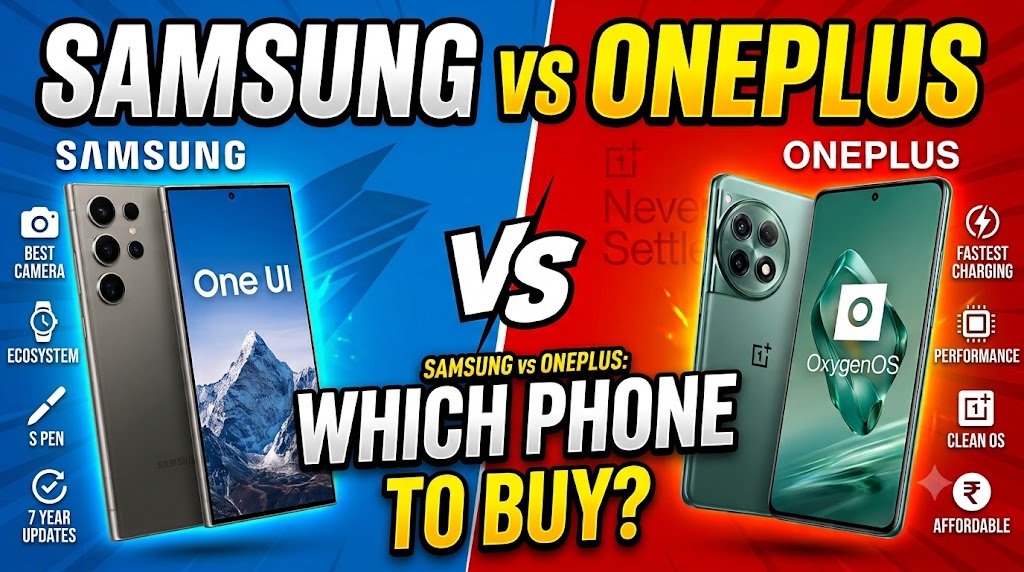
Thumbnail Image SEO Information
File Name: samsung-vs-oneplus-which-phone-should-you-buy.jpg
Alt Text: Samsung Galaxy and OnePlus flagship smartphones compared side by side
Title: Samsung vs OnePlus: Which Phone Should You Buy?
Image Creation: AI-generated comparison thumbnail
Description: A side-by-side comparison image featuring Samsung Galaxy and OnePlus flagship smartphones for a smartphone buying comparison.
File URL: WordPress will automatically generate the final media URL.
🏷️ WordPress Tags
Samsung Galaxy, OnePlus, Samsung vs OnePlus, Smartphone Comparison, Galaxy S26 Ultra, OnePlus 13